How to Train Custom Foundation Models for Industrial Robotics
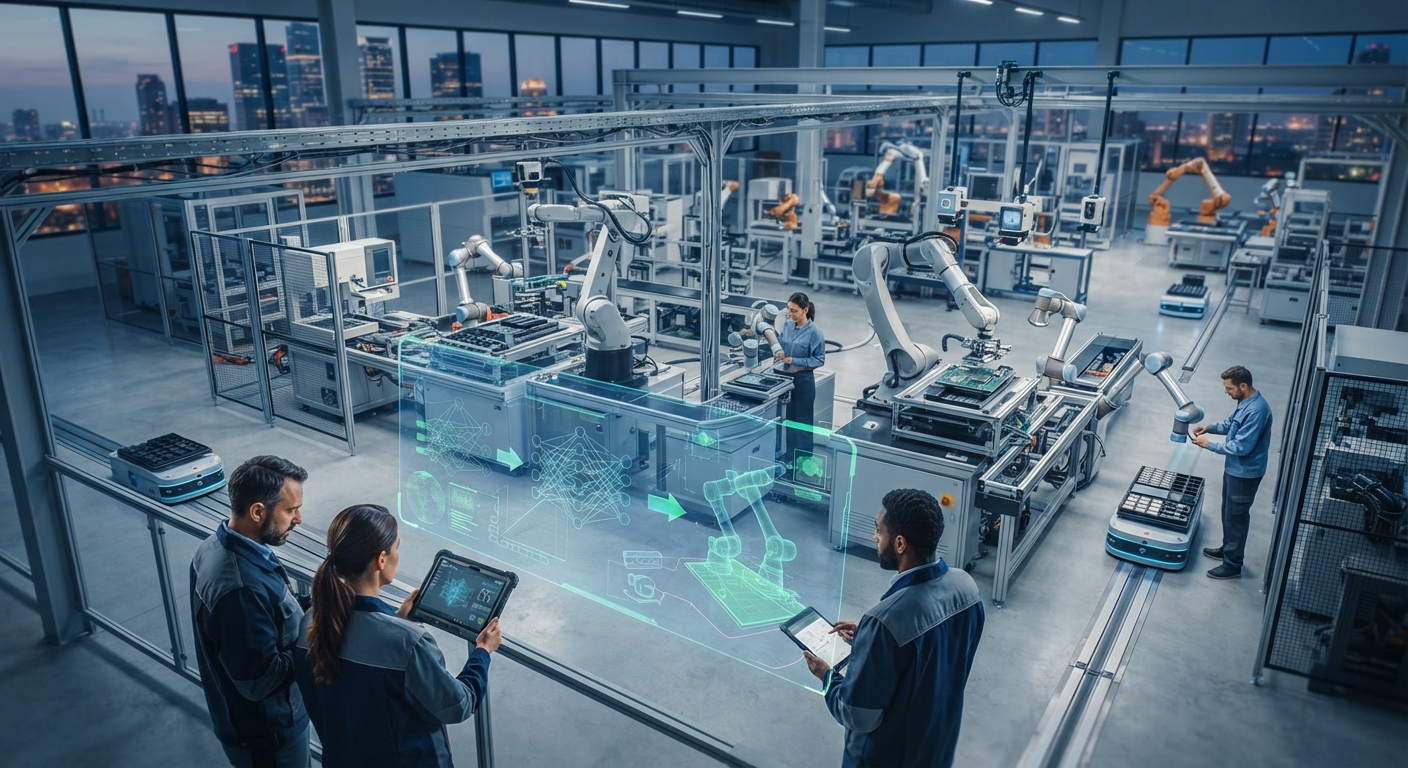
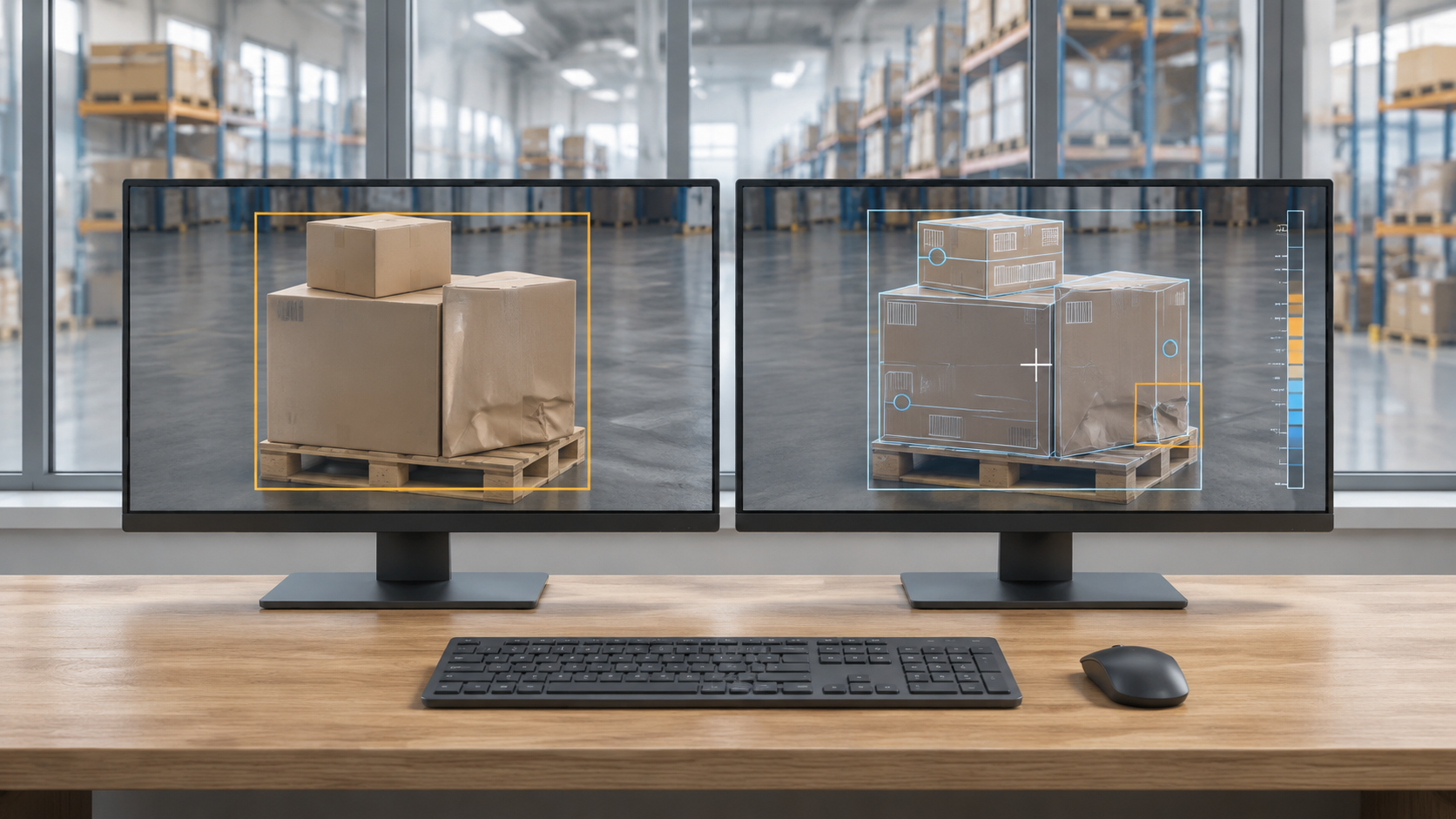
General-purpose AI models can write code, summarize contracts, and recognize everyday objects in photos. Put one inside a manufacturing cell or a high-bay warehouse, however, and its limitations show up fast. Industrial environments rarely look like curated internet datasets. Surfaces are reflective, lighting shifts across shifts, tolerances are measured in millimeters, and a wrong trajectory is not an inconvenience—it is a damaged actuator or a halted production line.
Training a custom foundation model for industrial robotics is how engineering teams bridge that gap. Instead of starting from zero for every new gripper, conveyor layout, or SKU, a domain-adapted foundation model builds broad physical intuition first and then narrows it down to your exact hardware and operational rules.
Step 1: Define the Scope, Embodiment, and Action Space
Before collecting a single frame of telemetry, you need clear boundaries around what the model actually controls. In industrial settings, ambiguity in the problem definition turns into instability on the floor.
- Embodiment Specs: Document exact degrees of freedom, payload curves, sensor placements, camera intrinsics, and control frequencies. A policy trained for a six-axis articulated arm with wrist-mounted stereo vision behaves very differently from one driving a mobile base with LiDAR.
- Action Representation: Decide whether the model outputs high-level waypoints, end-effector pose deltas, joint velocities, or direct torque commands. Separating high-level semantic reasoning from deterministic low-level motion controllers keeps safety boundaries easier to enforce.
- Failure Boundaries: Define what constitutes an unacceptable state—collision zones, maximum contact force, thermal limits, or minimum clearance—so those rules become part of your training and evaluation pipeline from day one.
Step 2: Build a Multi-Source Data Engine
Data is usually the hardest bottleneck in physical AI. Unlike text or web images, high-quality robotic interaction trajectories do not exist at scale on the open internet. Successful teams combine three complementary streams:
- Photorealistic and Physics-Accurate Simulation: Use synthetic environments to generate millions of randomized variations in object geometry, friction, mass distribution, lighting, and clutter. Simulation lets you safely explore edge cases—such as slipping parts or partial sensor occlusion—that would be dangerous or expensive to stage physically.
- Real-World Teleoperation and Demonstration Logs: Capture human-guided demonstrations on actual floor hardware. Even a few thousand clean trajectories covering nominal workflows and common recovery maneuvers give the model grounding in real contact dynamics, cable drag, and sensor noise.
- Autonomous Operational Telemetry: Once early versions run in supervised production or pilot cells, log every near-miss, human intervention, and atypical object pose. Those hard examples become the highest-leverage fuel for subsequent training rounds.
Aligning timestamps across RGB cameras, depth sensors, force-torque transducers, and joint encoders is critical here. A few milliseconds of clock drift between perception and proprioception can teach a model the wrong cause-and-effect relationship during contact-rich tasks.
Step 3: Choose a Base Architecture and Adaptation Strategy
Training a massive multimodal model entirely from scratch rarely makes economic sense for a single enterprise. Most production workflows start with a pre-trained vision-language or vision-language-action (VLA) backbone that already understands spatial layouts, object semantics, and basic physical affordances.
From there, adapt the model in stages:
- Continual Pre-Training on Domain Data: Expose the backbone to broad industrial imagery, CAD renders, assembly manuals, and unlabeled sensor streams from your facilities so it learns domain-specific visual cues—metallic glare, shrink-wrap reflections, pallets, fasteners, and safety markings.
- Cross-Embodiment and Multi-Task Policy Training: Train action heads across multiple related tasks—picking, kitting, bin sorting, surface inspection, or mobile navigation—rather than isolating each skill. Shared representations improve generalization when a new part geometry arrives on the line.
- Parameter-Efficient Fine-Tuning for Specific Cells: Use lightweight adapters or targeted fine-tuning to lock in the nuances of a particular workcell, tooling setup, or product line without erasing the broader physical reasoning learned earlier.
Step 4: Bridge the Sim-to-Real Gap Deliberately
A model that scores 99% in simulation can stumble immediately on concrete floors if the physics gap is ignored. Closing that gap requires structured randomization and physical calibration rather than wishful thinking.
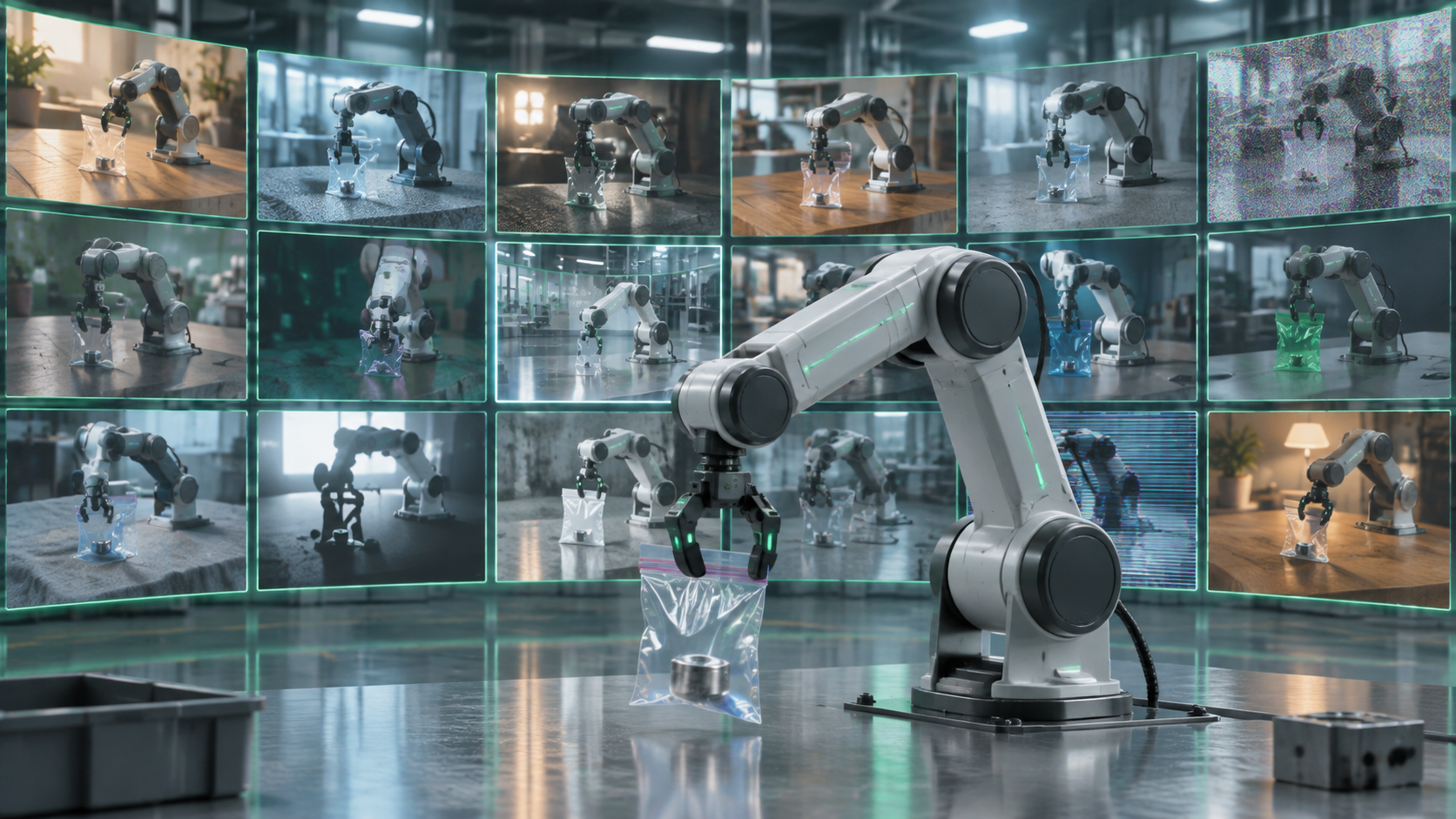
Randomize visual textures, camera exposure, actuator latency, joint friction, and payload center of mass during training so the policy learns to rely on invariant physical cues rather than brittle visual shortcuts. Pair that with system identification—measuring how your real motors, belts, and grippers actually respond to step inputs—and feed those measured parameters back into your simulator.
Step 5: Validate with Safety Gates and Shadow Deployment
Industrial deployment demands proof before autonomy. Before letting a newly trained foundation model drive live equipment unchecked, run it through progressive validation gates:
- Offline Replay and Stress Testing: Evaluate the model against held-out logs of rare anomalies, degraded lighting, and noisy sensor feeds.
- Hardware-in-the-Loop (HIL) Verification: Connect the inference stack to real controllers and safety PLCs in a contained test cell to verify deterministic latency and clean fallback behavior when confidence drops.
- Shadow Mode on Active Lines: Run the model alongside existing automation or human operators without giving it physical actuation authority. Compare its predicted actions against actual ground-truth decisions across thousands of cycles to uncover edge-case blind spots safely.
Step 6: Optimize for Edge Inference and Continuous Learning
A foundation model is only useful on the factory floor if it meets strict latency budgets. Quantization, operator fusion, and distillation into compact runtime backbones allow heavy multimodal reasoning to execute reliably on industrial edge compute without depending on round-trip cloud calls.
Once deployed, treat the model as a living system rather than a static binary. Automated drift detection, structured intervention logging, and periodic fine-tuning cycles ensure that as product lines evolve, tooling wears, and facility layouts shift, your robotics stack grows sharper with every operating hour.
About Denali Elevate Editorial Team
The Denali Elevate Editorial Team covers physical AI, robotics infrastructure, simulation, and enterprise deployment practices.