From returns chaos to managed logistics: How physical AI and Denali Elevate define 2026 trends
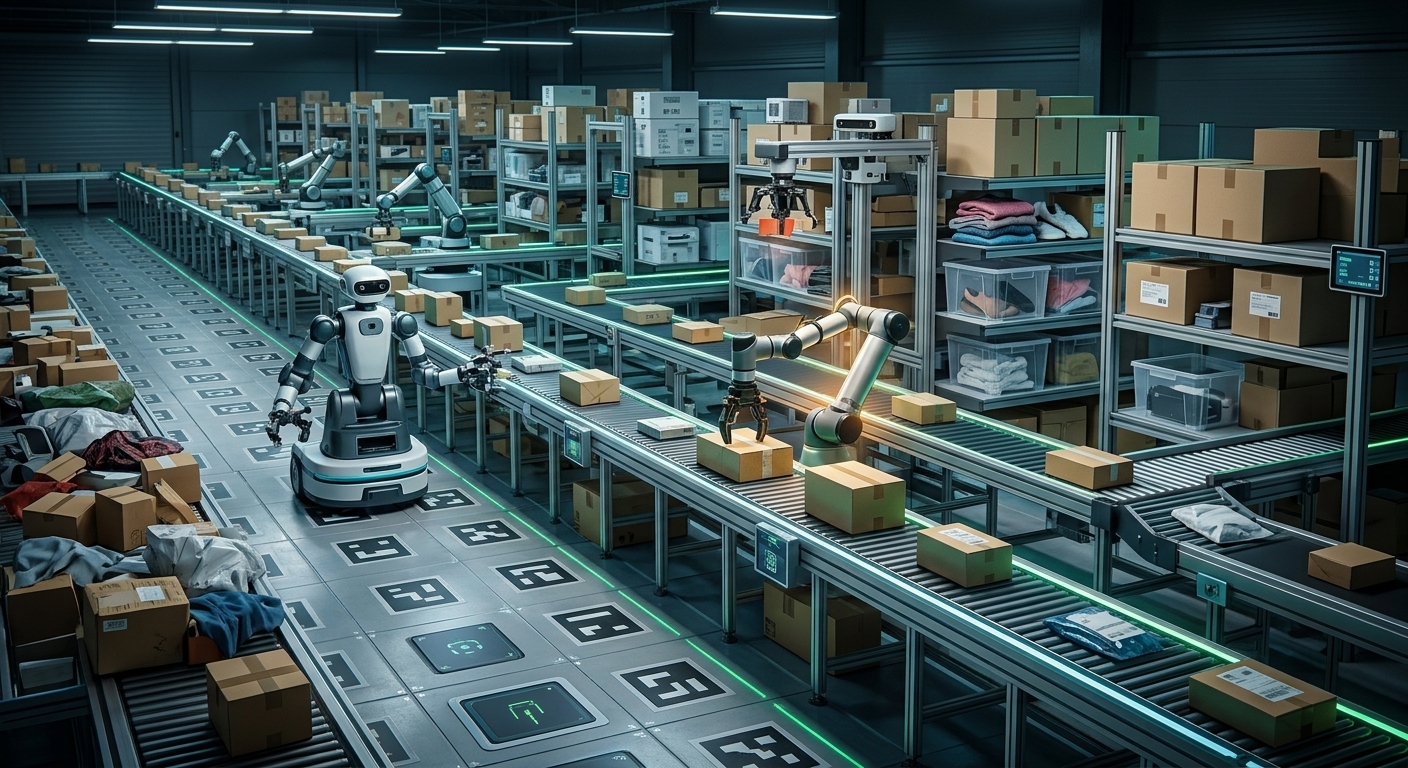
How adaptive Physical AI and Denali Elevate transform reverse logistics in 2026: multi-agent routing, 47% throughput gains, and scalable returns automation.
The defining shift in 2026 logistics is the transition from rigid automation to adaptive Physical AI. Reverse logistics, specifically returns processing, has become the primary proving ground for this technology.
Returned items arrive in unpredictable conditions, packaging, and orientations, making traditional pre-programmed robots ineffective.
To solve this, advanced technology stacks like Denali Elevate combine universal perception, navigation, and manipulation models into a unified platform.
The Denali Elevate tech stack for reverse logistics
The Denali Elevate platform resolves reverse logistics bottlenecks through four core components:
- Perception: Multimodal sensor fusion (RGB, depth, LiDAR) paired with vision-language models enables real-time scene understanding regardless of packaging variation.
- Navigation: Dynamic route planning maneuvers around moving obstacles, changes floors, and operates doors and elevators within fast-changing 3PL warehouse environments.
- Manipulation: Advanced grasp planning and dual-arm coordination allow robots to handle novel items without predefined templates, from soft apparel to fragile electronics.
- Locomotion: Adaptive gait execution and surface classification maintain stability across varying floor conditions.
These elements integrate via a sim-to-real pipeline: models train in simulation, clear safety boundaries, and deploy with continuous real-world monitoring and improvement.
Case Study: Multi-agent dynamic routing
Legacy automated guided vehicles (AGVs) using rule-based routing frequently cause aisle deadlocks and bottleneck peak operations. Denali Elevate’s multi-agent coordination models resolve this by allowing fleets to negotiate priority and dynamically re-route in real time.
Deployment results for a global 3PL provider operating 150+ AGVs include:
- Peak throughput: 47% increase
- Operational costs: 23% reduction
- Delivery lead time: 15% decrease
- Peak volume handled: 40% increase without infrastructure expansion
Applying these multi-agent principles prevents return-goods congestion, keeping the flow rhythmic from receiving dock to restocking.
2026 Industrial Deployments
Real-world deployments across Europe demonstrate that adaptive Physical AI is now a commercial standard:
- Otto Group & Sereact (Poland): Deploying up to 25 dual-arm robots powered by the Sereact Cortex platform under a Robotics-as-a-Service (RaaS) model for automated returns handling.
- Zalando, CEVA Logistics & Sereact (Germany/Poland): Dual-arm systems operating at facilities in Greven and Świebodzin. Closed-loop learning feeds operational data back into NVIDIA Isaac Lab to deploy updated models within days.
- Teradyne Robotics & Sereact: Announced at NVIDIA GTC Berlin 2026, combining the Cortex platform with Universal Robots cobots to transform custom setups into scalable off-the-shelf products.
Business Impact and Future Outlook
For fashion and e-commerce retail, slow return cycles cause severe value decay. Physical AI accelerates processing speeds, enables automated condition grading, and directly protects item margins.
Driven by Vision-Language-Action (VLA) models, simulation environments such as NVIDIA Isaac and Cosmos, and low-friction RaaS business models, Physical AI turns returns processing from a chaotic cost center into a scalable, predictable asset.
About Denali Elevate Editorial Team
The Denali Elevate Editorial Team covers physical AI, robotics infrastructure, simulation, and enterprise deployment practices.

