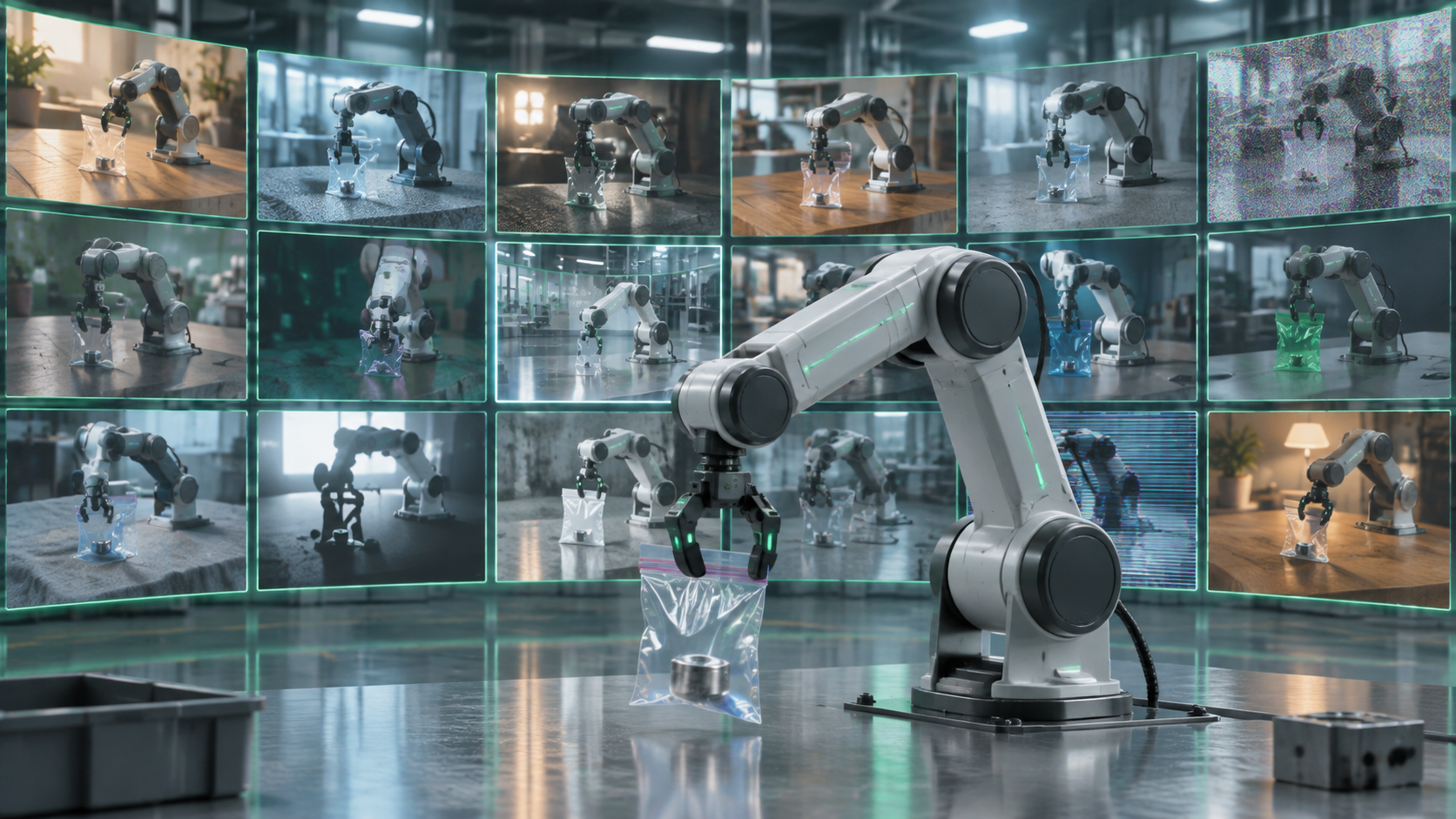
Deploying AI Safely: Why Traditional Validation Fails and What Replaces It
As autonomous systems move from structured, highly controlled environments into dynamic, human-centric workspaces, the question of safety becomes paramount. Unlike traditional software, physical AI interacts directly with the real world, where edge cases are infinite and the cost of failure is measured in physical damage or human injury.
Why Traditional Validation Falls Short
Historically, industrial robots were validated through exhaustive rule-based testing. Because they operated in cages and followed deterministic paths, engineers could mathematically prove their safety bounds. Modern AI-driven robotics, however, rely on deep neural networks that are inherently probabilistic. You cannot write a unit test for every possible lighting condition, obstacle configuration, or human interaction a robot might encounter.
The Software-in-the-Loop (SITL) Pipeline
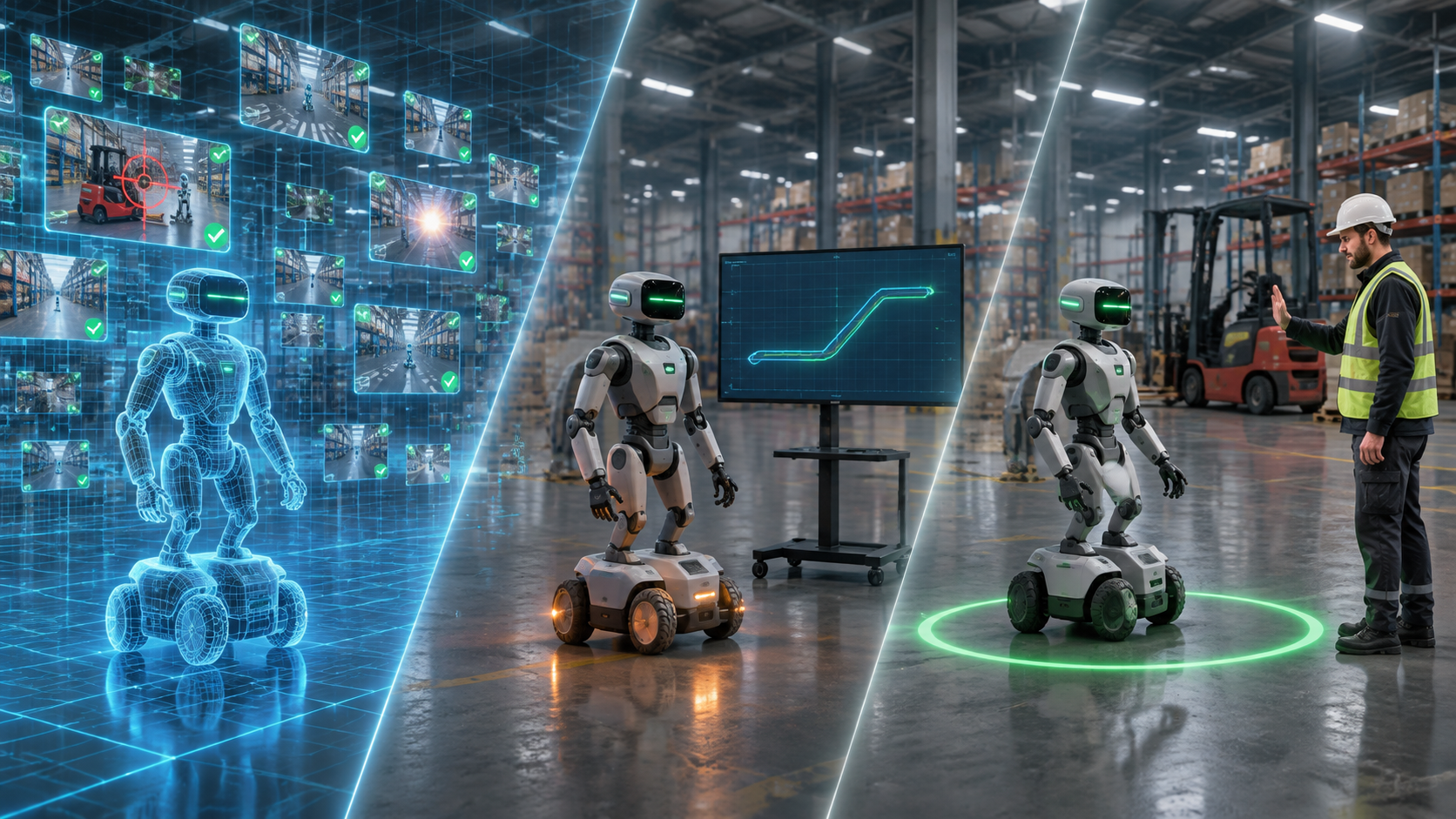
To bridge this gap, we have developed a comprehensive Software-in-the-Loop (SITL) simulation pipeline. Before any new policy or model update is pushed to physical hardware, it must survive millions of simulated hours.
- Procedural Generation: We procedurally generate thousands of warehouse and factory layouts, ensuring the model is tested against novel geometries.
- Physics Fidelity: Our simulation engine accurately models friction, mass distribution, and sensor noise, ensuring the virtual tests reflect physical reality.
- Continuous Integration: Every code commit triggers an automated suite of simulation tests, preventing regressions in safety-critical behaviors.
Adversarial Testing Methodologies
Passing standard tests is not enough. We employ adversarial AI agents whose sole purpose is to make the primary robot fail. These adversarial agents control dynamic obstacles, manipulate lighting to blind sensors, and create worst-case traffic scenarios.
By forcing the autonomous system to navigate these "nightmare scenarios" in simulation, we expose vulnerabilities in the model's decision-making process. If a robot can safely navigate a warehouse where forklifts are actively trying to cause collisions, it is far better equipped to handle the unpredictable nature of a real-world facility.
"Safety in physical AI is not about proving a system will never fail; it is about proving that when it encounters the unknown, it will fail gracefully and safely."
Real-World Validation and Shadow Mode
Simulation is only the first step. When a model graduates to the physical world, it enters "Shadow Mode." The new AI policy runs on the robot's edge compute, processing sensor data and making decisions, but it is not allowed to actuate the motors. Instead, its decisions are compared against the proven, existing policy or human teleoperation.
Only after the new model demonstrates statistically significant improvements in safety and efficiency during Shadow Mode is it granted physical control.
Conclusion
Deploying AI safely requires a fundamental shift in engineering culture. It demands a framework that embraces the unpredictability of the real world and uses massive-scale simulation to turn edge cases into known variables. By prioritizing rigorous validation, we ensure that enterprise automation scales without compromising operational safety.
About Denali Elevate Editorial Team
Denali Elevate Editorial Team is our Head of Safety & Compliance with 12+ years in AI safety and risk management. Previously at leading AI safety institutes.