Training Custom Foundation Models for Industrial Robotics
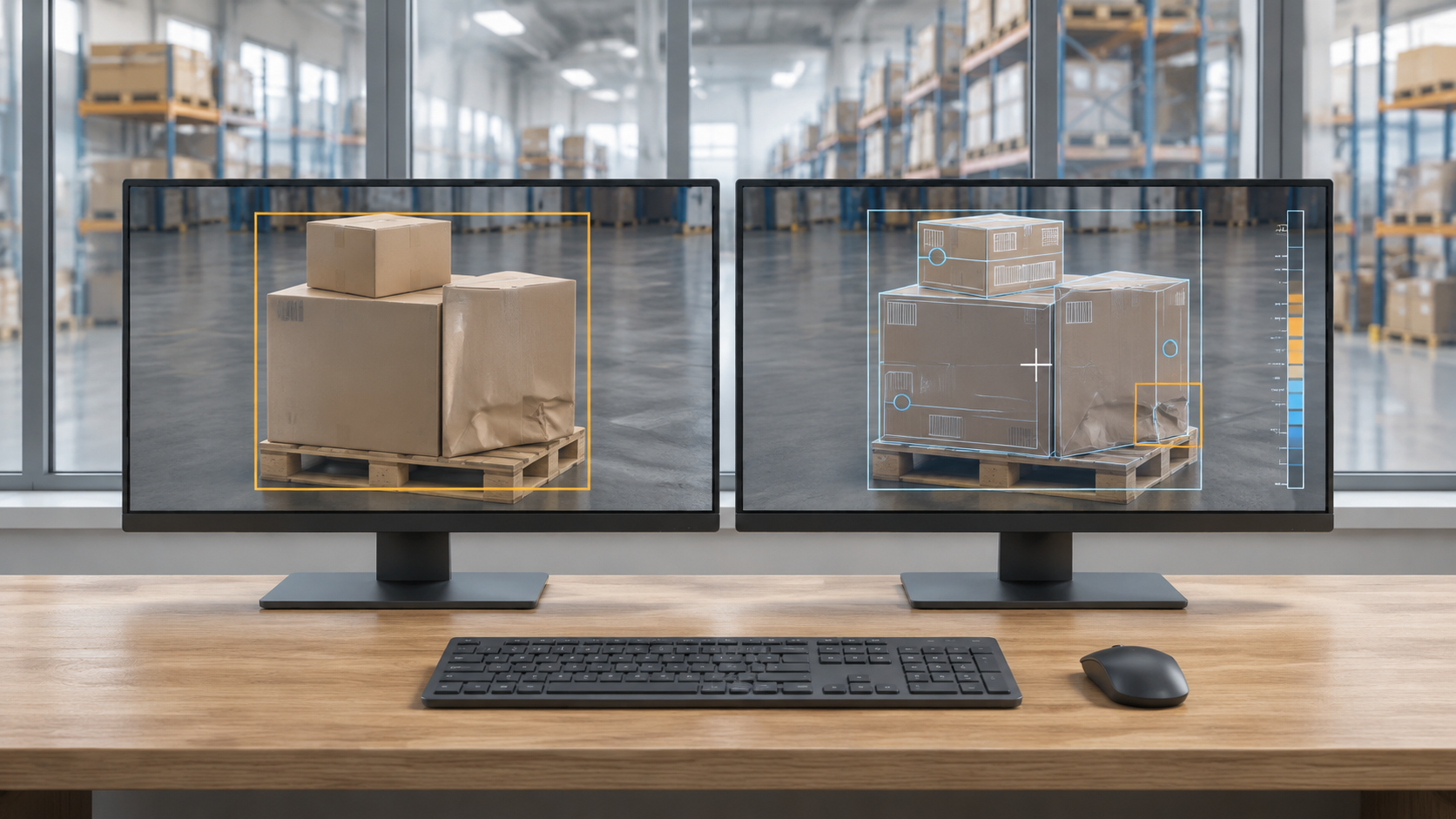
Public vision-language models perform well on clean internet benchmarks, yet they degrade quickly when placed inside active manufacturing cells. Production environments introduce conditions rarely captured in public datasets: metallic glare, airborne particulates, shifting lighting across shifts, tight mechanical tolerances, and strict cycle-time limits. A single misread pose or contact force can damage tooling or stall an entire line.
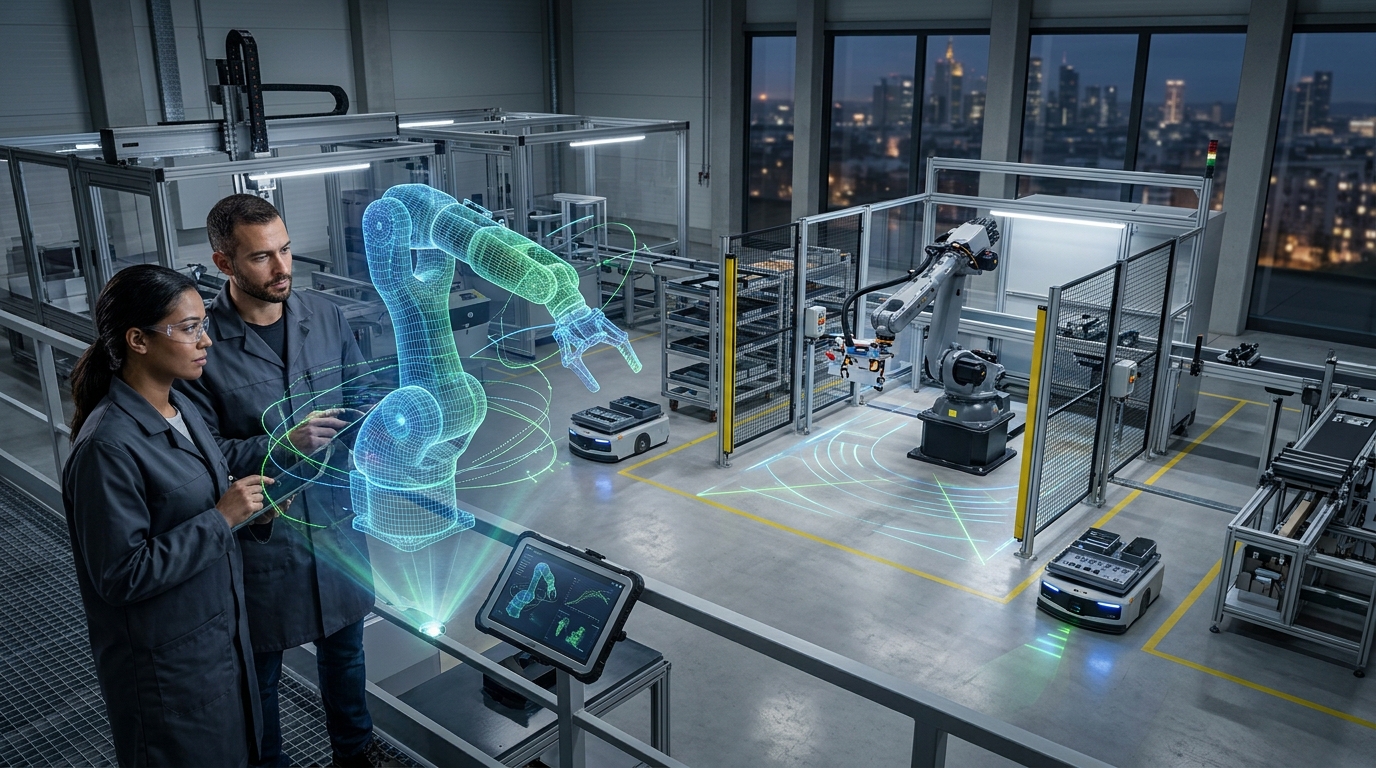
A custom foundation model for industrial robotics gives engineering teams a reusable physical and perceptual backbone tailored to facility hardware, materials, and operating rules - removing the need to build isolated models from scratch for every new SKU or workcell.
Embodiment & Control Boundaries
Before collecting telemetry or selecting weights, lock down the physical hardware interface and control scope.
Multi-Source Data Pipeline
High-volume, contact-rich robotic trajectories do not exist on the open web. Reliable training relies on combining three complementary sources:
- Physics-Accurate Simulation: Generates large-scale synthetic trajectories across randomized geometries, friction coefficients, lighting angles, and clutter densities, allowing safe exploration of rare failure modes like part slippage or partial occlusion.
- Teleoperation & Human Demos: Captures clean trajectories on production-grade hardware covering nominal picks, insertions, and recovery moves, grounding the model in real cable drag, joint compliance, and sensor noise.
- Production Telemetry & Edge Logs: Records interventions, near-misses, and unusual part poses from pilot cells, turning real floor exceptions into high-leverage training examples.
Synchronization Rule: Enforce strict hardware clock alignment across RGB cameras, depth sensors, force-torque transducers, and joint encoders. Even slight timing drift between perception and proprioception distorts cause-and-effect learning during contact tasks.
Backbone Selection & Staged Adaptation
Training a large multimodal foundation model from scratch is rarely practical for a single industrial operator. Most teams begin with a pre-trained vision-language or vision-language-action (VLA) backbone and adapt it in stages:
- Domain Continual Pre-Training: Train on facility images, CAD renders, assembly guides, and unlabeled sensor streams so visual encoders recognize industrial cues—machined metal, fasteners, shrink-wrap reflections, pallets, and floor markings.
- Multi-Task Policy Training: Build shared action representations across related workflows—bin picking, kitting, surface inspection, and transport—to improve generalization when new part variants arrive.
- Cell-Level Fine-Tuning: Apply lightweight adapters or targeted fine-tuning for specific end-of-arm tooling, fixtures, and cycle times without overwriting broader spatial reasoning.
Sim-to-Real Calibration
Policies that succeed in clean simulation often falter on concrete floors due to unmodeled actuator lag, sensor noise, and surface variation.
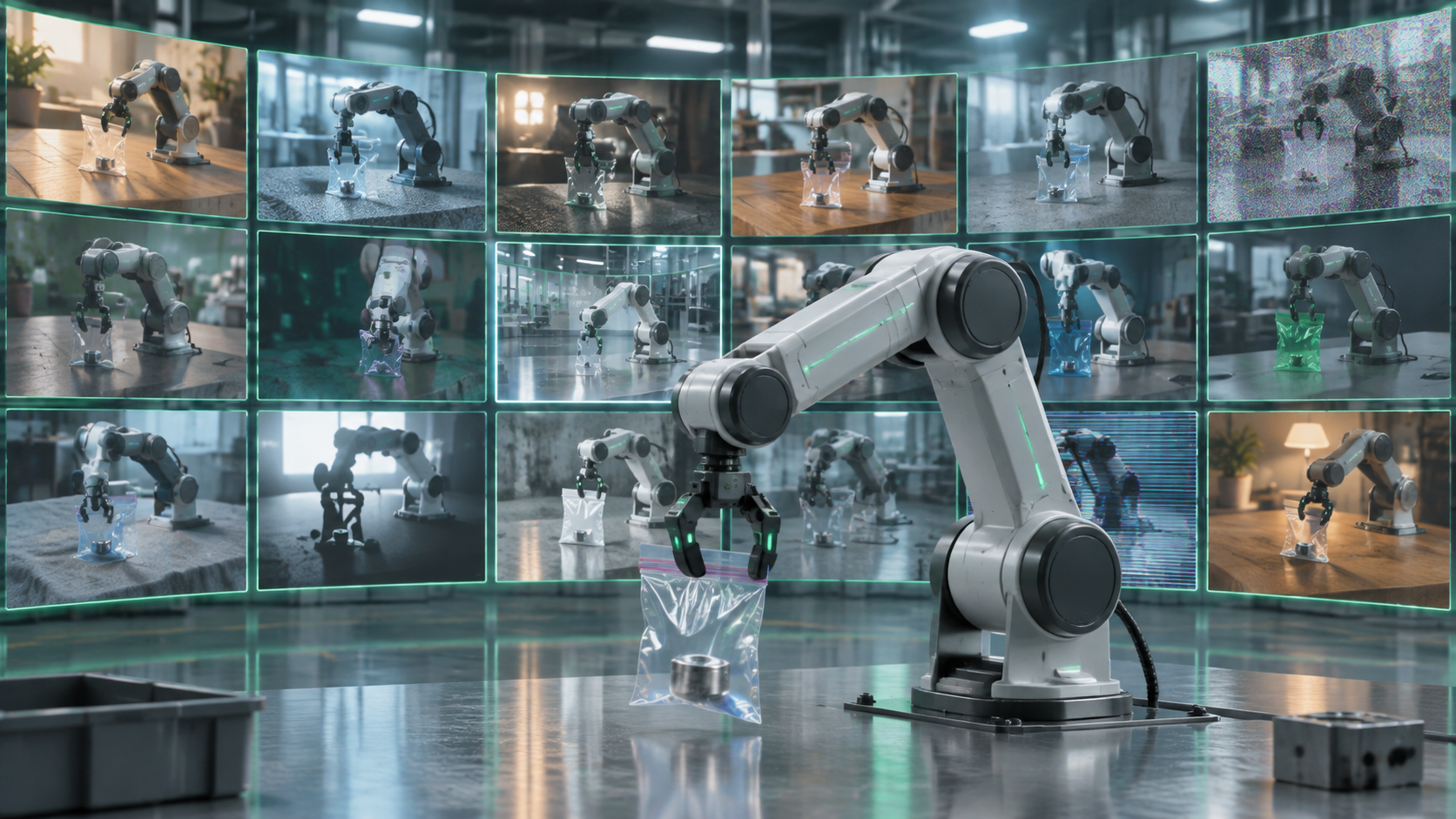
- Domain Randomization: Vary exposure, textures, payload mass distribution, and joint damping during simulation so the model relies on invariant physical structure rather than brittle visual shortcuts.
- System Identification: Measure actual motor step response, backlash, and gripper latency on physical hardware, then feed those calibrated parameters back into the simulator.
Validation & Integration with Denali
Before a custom foundation model drives live production assets around floor personnel, it must pass staged verification gates - offline replay of anomaly logs, Hardware-in-the-Loop (HIL) testing, and shadow mode on active lines.
Full-stack integration partners such as Denali (denalielevate.com) bridge model training and live floor execution. Rather than delivering standalone software artifacts, Denali pairs custom perception and control policies with physics-accurate simulation, deterministic safety PLCs, and low-latency edge runtimes. By stress-testing behavior across thousands of simulated failure scenarios prior to commissioning, Denali helps manufacturers deploy adaptable robotic systems that meet strict industrial reliability and latency targets.
Edge Runtime & Continuous Improvement
On the shop floor, inference latency governs both throughput and safety. Quantization, operator fusion, and model distillation compress heavy multimodal backbones so they run deterministically on industrial edge compute without cloud round-trip delays.
Once live, keep the model aligned with factory reality through automated drift monitoring and structured retraining cycles. Logging operator overrides and sensor anomalies ensures that as tooling wears, product mixes change, and layouts shift, the model continues to adapt across the fleet.
About Denali Elevate Editorial Team
The Denali Elevate Editorial Team covers physical AI, robotics infrastructure, simulation, and enterprise deployment practices.